
Reshaping My Studio
Like many of you, January has me thinking about resolutions and intentions for the year ahead – particularly for my art studio practice. Yet I know from past experience how hard it can be to convert good intentions into action and change. Old habits die hard. Motivation is elusive. And willpower is a weak engine. With this in mind, I’m starting the year off by going back to basics. Which, as an environmental psychologist, means taking a hard look at my environment and pondering how I can get it to better support me in doing the things I want to do.
Decades of research have shown that our environments strongly influence who we are, what we think, and what we do. The good news, in terms of new year’s resolutions, is that once we are aware of some of these influences, we can change our environments to help change ourselves.
But what is an environment? For environmental psychologists, an environment is not just the physical place but the entire context or circumstances in which we find ourselves. An environment is what’s “out there” as opposed to what’s inside your head – it includes physical places of course, but also the social world, the digital world, the information that surrounds us, and even the way that time itself is structured.
It’s a lot to think about, so I am taking things one step at a time, starting with my studio space.
There are many general recommendations for creating environments that support mental well-being, creativity, and getting things done – things like nature, natural light, quiet zones for incubation, open areas for collaboration, and a décor that is visually rich but not too distracting. Yet there is no one size fits all. What will be supportive for any one person or group depends on their specific goals, their expectations, and their idiosyncrasies.
So instead of following other people’s recommendations or being seduced by Pinterest images of exquisitely designed art studios, I started by thinking about my own personal needs.
What do I want to be doing or feeling in my studio space? How can my environment help make that happen?
What do I need from my studio space?
My brainstorming on needs yielded some obvious things – like my need for another easel. But it also uncovered less obvious but equally important needs, like:
Being able to find the tools and materials I need without spending too much mental effort (or ideally, no mental effort if I’m in the flow).
Feeling comfortable and free in my space. I need to be able to experiment with crazy ideas, dance around, or simply stare into space for long periods of time without feeling that I’m being watched or judged.
Helping myself remember what’s important amidst an often-overwhelming morass of ideas and imagery.
Once I dug deep into the things I needed from my space, I began to consider what I could change about my studio to support those needs. Are there barriers to meeting my needs – things that are actively working against me? Are there things that could be added to make my space more supportive of my needs?
Removing barriers and adding support
Three things topped my studio brainstorming list for how to improve my space:
Removing an over-abundance of choice
I am a compulsive collector of art supplies and things that could become art supplies. It’s gotten to the point that when I’m out with my kids and we come across a discarded object or some packing materials, they jokingly ask, “Could it be used for art?”
Having a large variety of things to explore and choose from is important to me, but I also know that less often leads to more – more focus, more clarity in the work, more progress. How can I reconcile these competing desires? The way I currently have things organized lets me easily peruse a multitude of possibilities when I am in an experimental stage of my work. But I realize that I also need a way to limit my choices by keeping the majority of tools and materials out of sight – and out of mind – when I am ready to shift from broad experimentation toward more focused work.
I wonder – would it help my focus if I selected the small subset of tools and materials relevant to my current work, organized these within easy reach of my painting space, and stored everything else out of sight?
Removing watchful eyes
I was surprised to discover that a lack of privacy may be adversely affecting my work.
I thought I had solved my need for privacy when I moved into a new studio a year and half ago. My previous studio consisted of a partitioned cubicle within a large old factory. Although I had walls partitioning off my space, the top of the cubicle was open, allowing anyone to look down from the mezzanine above and leaving me feeling vulnerable – as if my fledgling impulses and experiments were at risk of attack from above. This didn’t make much logical sense, but the primitive brain that worries about predators is still there, affecting how we think and feel.
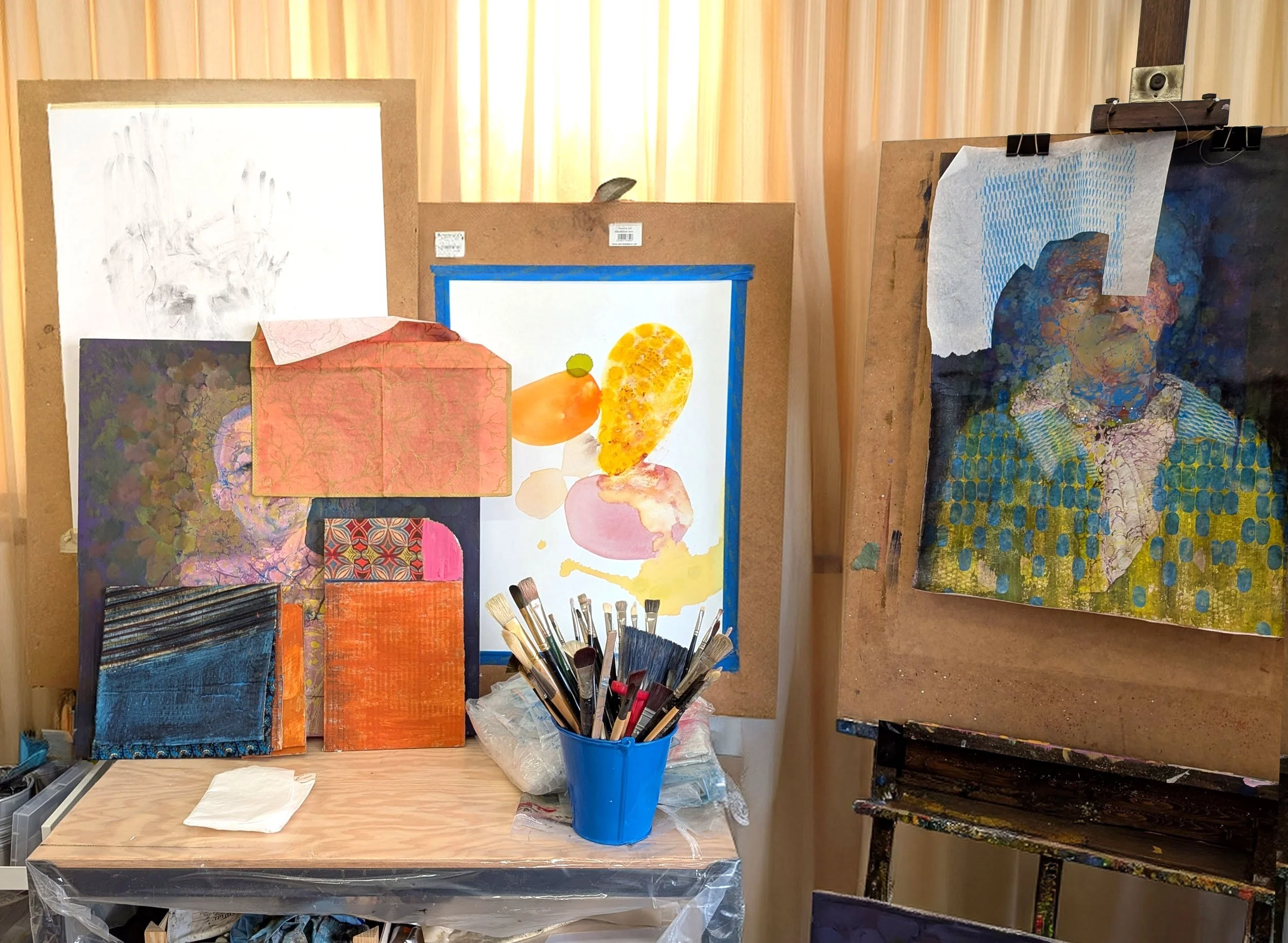
My new studio, though, is a fully private space – complete with ceiling and nice large windows. Curtains have been pretty far down on my list of studio improvements – they seem mostly aesthetic and anyway, I like the light. But as I considered how my space made me feel, I realized that the urban street and apartments outside my windows were hijacking part of my brain power. My rational brain didn’t care that people might be looking in at me, but my primitive brain clearly did and it was reacting by putting a break on my free expression.
I could just continue to tell myself that I don’t care what people think but I wonder – could I could help myself out with the simple addition of curtains?
Adding a mini-brain
I am collector not just of art supplies, but of ideas and inspiration. This collection provides a deep – but also woefully cluttered – creative well.
It would be a big help, I realized, if I had a simple way to keep my current and most relevant ideas, intentions, and inspirations stored outside of my overtaxed brain and in an easily accessible place. What have I been thinking about related to a particular piece or body of work? Which of the many inspiring ideas and images I’ve come across are relevant? Where do I want to start the next studio day?
I wonder – would a simple and well-curated “inspiration and idea” corkboard near my painting space help me to pluck important things from the sea of information in my brain, my computer, and my journals and make them visible?
Change your environment, change yourself
Which small experiment did I start with?
I picked the thing that was the easiest and that also just might have the biggest impact. Last week, I put up some simple curtains. This week, I will see if they help.
How about you? What do you want to do or feel in your space? What is one simple change you could make to help support your intentions?