
Reshaping My Information Landscape
Over the winter holidays, I luxuriated in a delightfully slow consumption of information. I read several novels. I had long chats with my family and friends. I slowly leafed through art books while drinking tea. I took a break from the fast-paced information streams of my newsfeed and social media accounts.
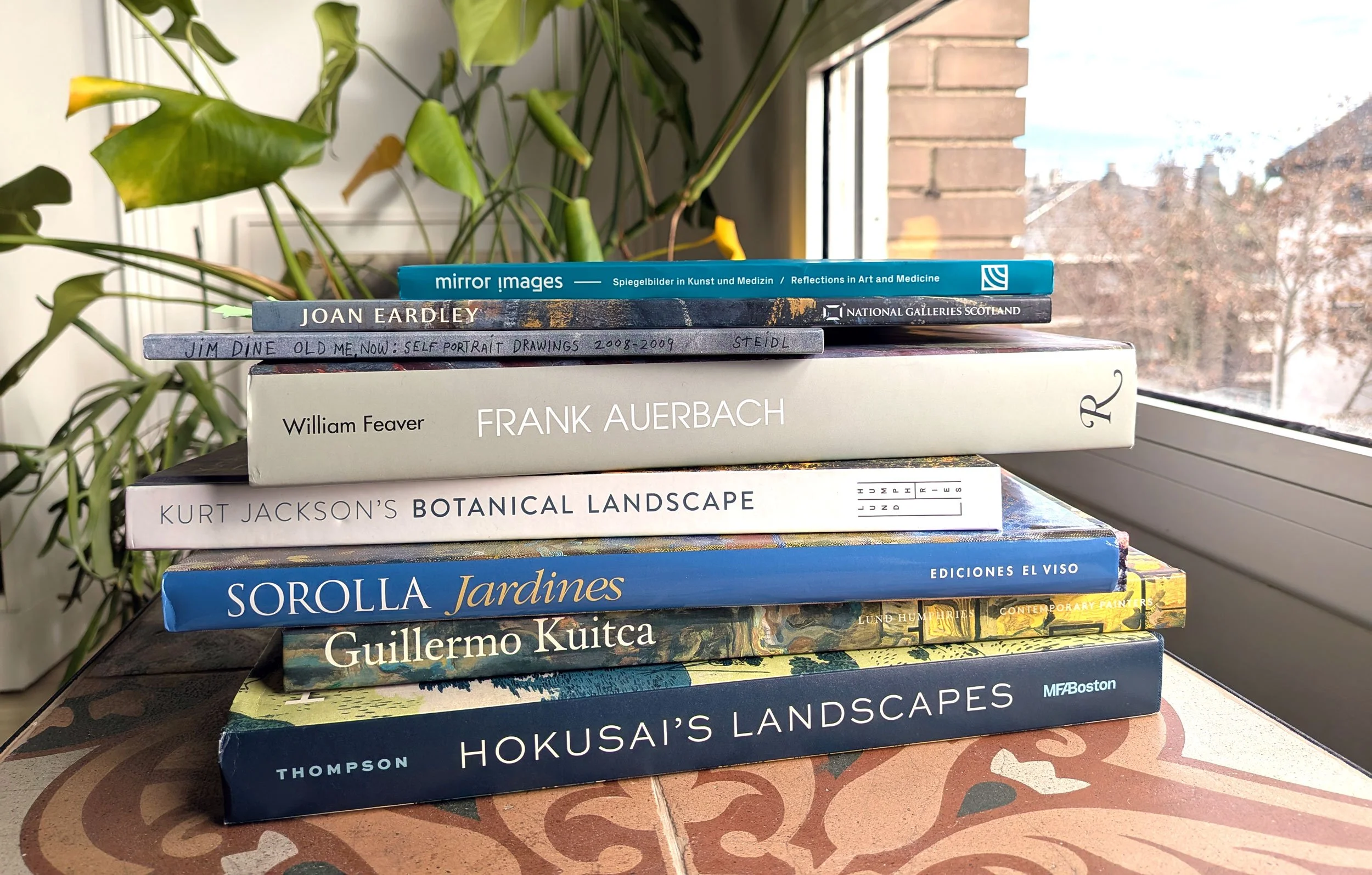
Surrounding myself with a slower-paced environment of information was not only relaxing, it was rewarding. I found that I had more time to process what I was consuming. Information was more likely to lead to ideas. And those ideas were more likely to stick around.
As I think about the year ahead, I realize that I want more of this – in my life in general and also in the information that I consume related to my creative practice.
In my last post, I wrote about how I am taking a hard look at my art practice environment and pondering how I can get it to better support me in doing the things I want to do this year. That post started the process by looking at my physical environment – my art studio – and thinking about the changes I could make to help myself out. (In case you were wondering, the curtains have set me free.)
In this post, I turn to the more abstract yet formidable power of the information environment. What does my world of information look like? How might I reshape it to better support my needs and intentions?
What I’m up against – the modern information environment
Back in the days of my childhood, the information that surrounded me could be more or less consumed at a sustainable pace. There was simply less of it demanding attention. We listened to long-form radio programs while making dinner. We read beyond the headlines when sitting down with a newspaper or magazine. We listened to entire albums as an activity. We turned off the TV after a favorite program because the commercial break gave us the opportunity to disengage.
This more leisurely pace of information consumption was well matched to peoples’ powerful yet finite brains. We were less likely to suffer from information overload. And we had time to process what we were consuming – to focus, to ruminate, to make connections.
But those were the old days and information consumption has long been more like trying to drink out of a fire hose – the flow is fast and furious, almost impossible to swallow, and yet strangely addictive. I, for one, continually place myself directly in the stream, mouth wide open, afraid of missing a drop.
But I am increasingly aware that surrounding myself with a relentless stream of information has turned me into a collector rather than a connoisseur. I am like a magpie, stockpiling shiny information and imagery just as I stockpile art supplies. The act of collecting feels like I am filling the well from which creativity is drawn. And yet – as anyone who has known a hoarder knows – collecting and saving can take on a life of its own, leaving you with nothing but a space full of unused items that hold the promise of opportunity while actually making it progressively harder to move.
What could better look like?
We do not have complete control over the information that surrounds us and demands our attention. But there are definitely things we can do to push our information environment in a more supportive direction.
Much has been written about the need to make information consumption more intentional – to remove distractions and reduce the amount of mindless scrolling or passive consumption that is more and more designed to evoke an emotional response rather than to inform.
But just as important as reducing the sheer volume of low-quality information is increasing the nourishment that we derive from the information that we do consume. When it comes to information volume, less is often more. But when it comes to information processing and exploration, more is often more.
In terms of my own information environment, I’m looking to make changes both in what I consume and how I consume it. How can I support my needs and intentions by filtering out low quality information? How can I get more out of the information that I do let in?
What am I trying?
I have come up with three ideas on how to tweak my environment to help me consume less and process more:
Plant my environment with more nutritious information. The brain has an almost insatiable appetite for information, so it helps not just to try and cut back on empty information calories, but to replace that with information that is more nutrient dense.
With that in mind, I am following longer-form trusted news sources more and reading headlines less. I am creating rules for myself around social media that have me scrolling less and processing more. And during the work week, I am replacing Netflix with books.
Use an inbox as a gatekeeper. I’m continuously coming across information that I want to save – an article that might be useful for a blog post one day, an image that inspires me, a quote that strikes a chord. In my efforts to hang on to these informational nuggets, I have been putting them in folders with names like “useful articles” or “images for inspiration.” This gives me the illusion of having captured the information but, in reality, has only made it easy to forget.
My new strategy is to put information that seems worth saving into an information inbox. On my desktop I use a simple inbox folder and, on my phone, I use the “note to self” option on the Signal messaging app.
I am finding that the inbox acts as a gatekeeper on information in two ways. First, to be worth putting in my inbox I require that it be accompanied by a short note on why it’s interesting. This is an admittedly low bar, yet some things don’t make the cut. Second, to be worth eventually taking out of the inbox and processing, the information has to still feel interesting. This is a higher bar and I find that many of the things I felt compelled to save really aren’t that interesting upon further reflection.
Create a system to encourage information processing rather than information collection. What is to be done with the information in my inbox? Like any inbox content, it must eventually be processed. And as much as I want to rely on my own brain for information processing and hope for the best, I know that I need support.
As a small experiment, I am exploring the Zettelkasten method of note-taking and information processing using the open-source Obsidian app. The idea is to avoid plunking information and ideas in static folders and instead process them at a deeper level in order to build an interconnected web of ideas.
So far, I am finding that this method encourages me think more deeply about the information I’m saving – not just what it says, but why it matters to me, what other ideas it relates to, what questions or explorations is suggests. On the other hand, it also requires that I set aside time to process my inbox – something that is proving easier said than done.
What’s Working?
Almost everyone I know suffers at times from information overload and could use some help filtering information and getting more satisfaction and meaning from the information they do consume. Leveraging the environment – whether that’s in the form of removing distracting or low quality information or in the form of adding structures and systems – can be a powerful way to provide that help.
Which changes and tools will help the most? It depends on your specific environment and needs. I see signs that my tweaks are helping me, but I will need to let my small experiments run a bit longer to see if that change is sustainable. Perhaps I will report back in a future post.
In the meantime, I’d love to hear from you. How have you shaped your information environment to better support your own intentions?