Eighteen Small Experiments
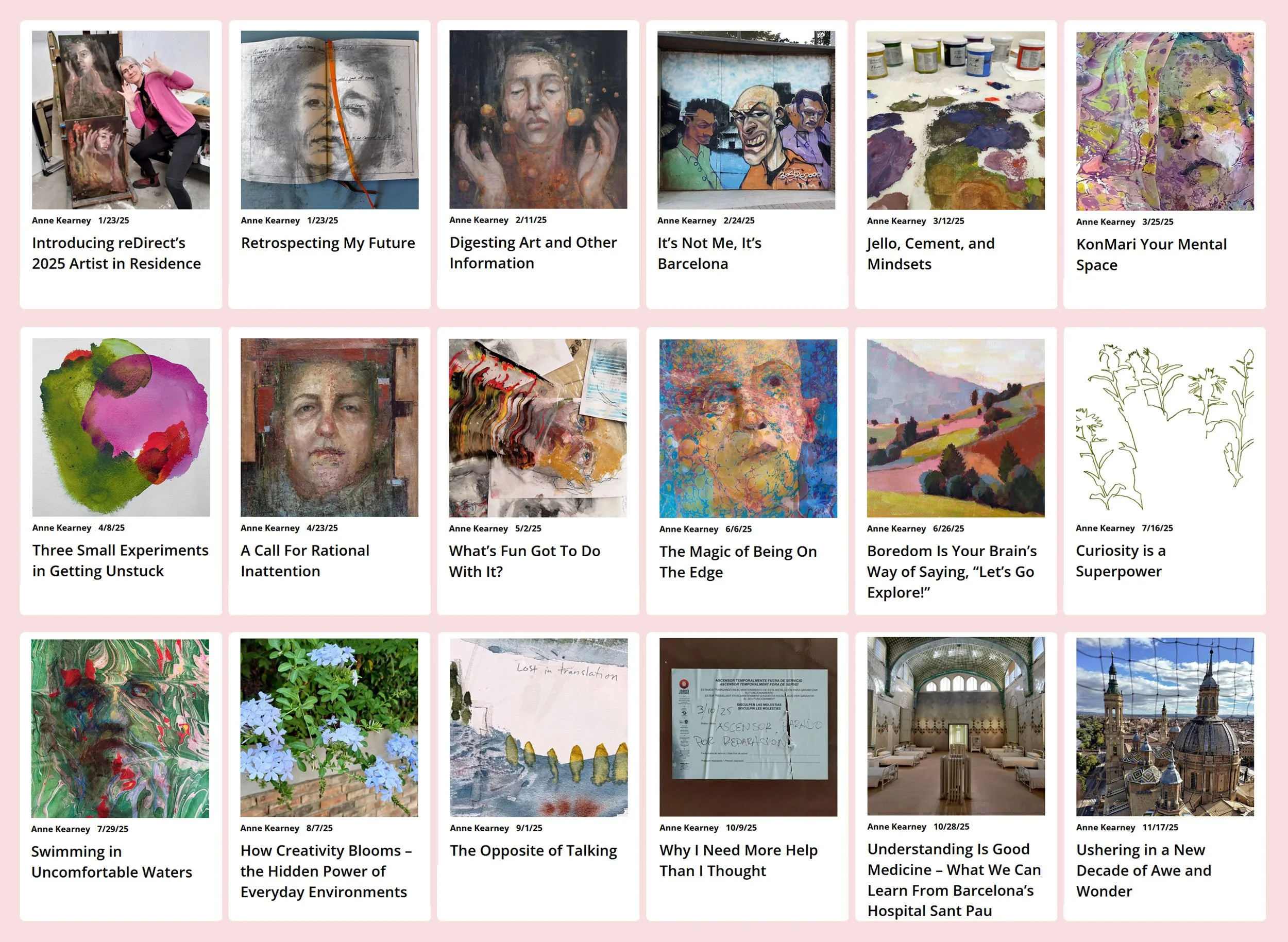
I have been conducting experiments and you have been part of my laboratory. In the past year I have written eighteen blog posts – including this one – as part of my work as artist-in-residence for reDirect. It has been a process driven by curiosity and a loose commitment to the “small experiment” framework as described by psychologist and reDirect founder Rachel Kaplan.
What are small experiments? You may have run one today without even realizing it. Maybe you switched up your morning routine, tried a new strategy at work, or cooked with what was on hand rather than what the recipe called for. We run these little experiments all the time – it is part of being an inquisitive knowledge-hungry human.
Most of these experiments vanish into the fabric of daily life – we don’t name or track them and we often quickly forget them. But if we are a little more intentional, we can elevate some of these exploratory acts into the realm of scientific inquiry. I’m not talking about the big science of large controlled experiments. I’m talking about a smaller kind of experiment that falls in the fertile middle ground between big science and everyday intuitive exploration.
Small experiments are well thought out but simple enough to do without a huge amount of preparation, resources, or scientific expertise. They are meaningful enough to matter but small enough to be manageable. They address real issues but at a scale that is doable. They include an evaluation but don’t require complicated analyses. They are imperfect but informative.
My small writing experiments were certainly not perfect. I didn’t systematically vary the content of my posts in a predetermined way and I didn’t have any control over who was reading. But yet there was intent and thought behind my experimentation. Throughout the year, I was trying things out – albeit organically – by varying the posts’ topics, lengths, and formats. And now, at year’s end, I am closing the experimental loop by evaluating my series of small experiments, reflecting on what I have learned, and thinking about what it means for the next round of writing experiments in the upcoming year.
How can I tell how it went?
Evaluation can be a tricky business because we never have perfect information. But we do the best that we can. For my evaluation, I gathered information and feedback from three main sources:
Metrics: I looked at the number of newsletter and website opens for individual posts along with the number of comments that posts received. And while I was at it, I reminded myself that these metrics, like many readily available quantitative metrics, are imperfect and best taken with a grain of salt – or at least a healthy skepticism about what they are actually measuring. I also gathered what information I could about my audience.
Self-Reflection: I spent time reflecting on this past year of posts. What did I enjoy writing about? Where was I spending the most effort and was that valuable? What was a struggle and why?
Input from my readers: I invited seven regular readers to share their perspectives by answering a few questions.
A few things I learned
My readers are a curious and thoughtful bunch but are otherwise hard to put in a box. You are artists, academics, psychologists, design professionals, non-profit leaders, and other people interested in a wide range of issues at the intersection of creativity, environmental psychology, and the human experience. It is not surprising then that while some posts were more popular overall than others, everyone had their own favorite.
It was good news to me that people like the mix of the personal and the science because it is at this intersection that I have the most fun writing. It was also nice to hear that the artwork and photos are appreciated – I like sharing them.
The value of “failed” experiments
The only failed experiment is one that is not well thought out or that is sloppy in its implementation. Experiments that don’t confirm your suspicions or bring good news are just as successful as those that do – they all provide useful information and ideas for what to try next.
These were some of the things that didn’t work as well for me and my audience, along with the questions they raise for next year:
Some people had no problem with my longer posts, but overall, they were not as widely read as the shorter ones. Even the most interested reader has limited bandwidth these days. How can I rein in the length of my posts? Is there a better outlet for longer form posts?
Writing takes me a long time – sometimes too long. How can I streamline or better organize my writing process? Can I timebox the research that I do for posts?
Some topics proved more unwieldly than I initially thought and this meant that I got mired down in the writing process. How can I more quickly identify when this is happening and tighten up my focus earlier?
Recalibrating for the year ahead
Based on my year of small experiments, I’m strategizing on tweaks and new experiments for the year ahead.
Treating my blog as a laboratory rather than a performance is freeing. It relieves the pressure of having to fully know what I’m doing in terms of content, format, and audience before I begin and instead allows me to incrementally find my way.
It also means that you, dear readers, are part of the process.
If I didn’t reach out to you as part of my small experiment evaluation it doesn’t mean that I don’t want to hear from you – I value what you think! Which posts over the last year resonated with you and why? What would you like to see next year?