
SEE Lens: Understanding and Exploration
You, too, were probably an annoying toddler. You did what most 3-year-olds do, but you didn’t know it. Nor did you mean to be annoying or realize that you kept asking the same question. You were simply on a necessary mission, like most other toddlers; a mission that never ends.
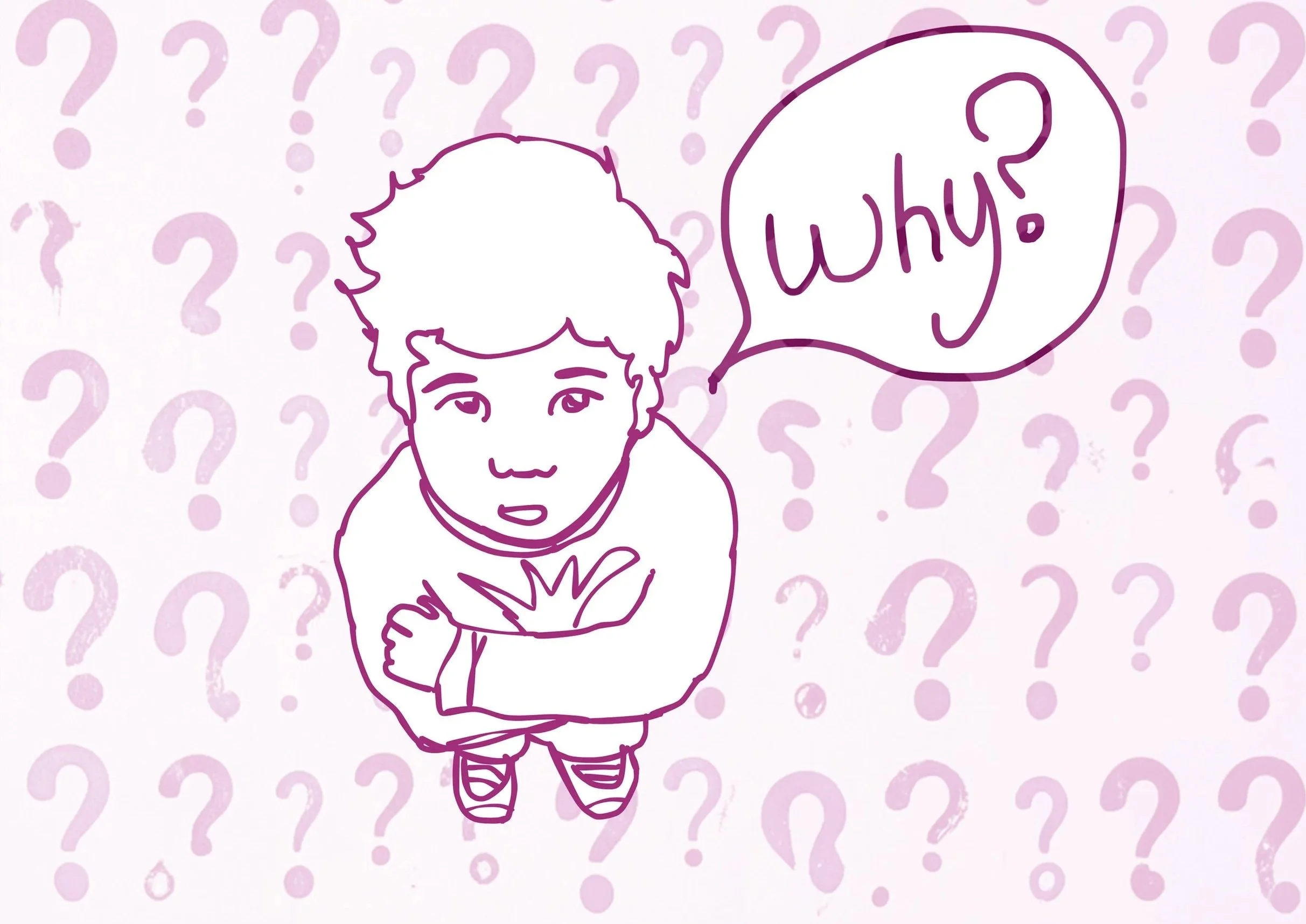
Illustration by Rachel Schad
Why? Why…why…why.. and more of the same! Three-year-olds famously and endlessly ask that simple question. They want a genuine answer, and they want it right then. The likely “reward” for an answer is another inquisitive why, now with respect to the new information.
Why do we keep answering these questions? You see,‘why?’ isn’t just a toddler question! The underlying reason for the question is no different for any of us, across demographic categories, and throughout our lifespans. Providing “useful answers” is an unending challenge. Why do we persist in asking the question when we so often don’t get a useful answer? We may not even remember why we asked by the time an answer emerges. Why do we settle for –or even provide – answers that are misleading, untrue, or deceptive? Why are there so many contradictory answers to the same question? Why…why…why…
In the jargon of the SEE framework (Supportive Environments for Effectiveness), the answer to these questions is Understanding and Exploration. The three-year-old is trying to make sense of (or understand) everything and anything. That requires seeking answers, i.e., exploring possibilities, to resolve the quest. As adults, we still need to make sense of mundane momentary issues swirling around us, as well as the existential dilemmas that cast shadows on tomorrow. Neither belief nor disbelief resolves the desire to understand, so we continue to explore more satisfying solutions.
Portable Gizmos
Fortunately, even before we can ask our first “why” question, we have already begun the process of wondering; in other words, we are born motivated to seek answers! For 300,000 years, give or take a few, we humans have arrived with fabulous, tiny portable computers that require no upgrades or passwords. They come ready to take on a huge range of situations and tasks, incorporate new material (aka information), and pivot if circumstances call for a change of tactics. Not only that, but our gizmos include mechanisms for retrieving stored information on demand.
What an awesome ancient machine! Life nowadays bears little resemblance to 300,000 years ago, yet the device that enabled our ancestors to explore their surroundings and enhance understanding is still the core tool for exploration and understanding today. Our gizmos – our brains – have always depended on a diet of information.
Before any of us could sit, stand or toddle (or ask annoying ‘why’ questions) we were surrounded by a huge amount of information from our physical, temporal, and social environments. A great deal of the information is repetitive – light patterns, sounds, shapes, people, admonitions. An infant’s brain may not be aware of such minutiae, but it is tuned in to information and to its repetitions. OK, repetition may amuse infants, but wouldn’t the rest of us find it boring, maybe even annoying like the repeated why questions?
Yes and no. Repetition is powerful. That’s how we all learned to identify shapes, eventually recognized that the person smiling at us will attend to our tears, acquired our “native tongue,” and learned to read. Where would advertising be without repetition? We hear a jingle often enough and know what to expect; we see a logo often enough and the “right” associations come to mind. In other words, repetitions build familiarity and create predictability!
Wow! By experiencing similar patterns many times, repetition allows our awesome gizmos to predict or anticipate. But what if the repetition-anticipation cycle fails? Sometimes—as with humor – those might even be planned “failures” or welcome surprises. More often, however, when the expected next step doesn’t happen, the result is confusion and frustration. In other words, the failure of prediction can be costly, leading to chaos, helplessness, and anger.

©Daniel Brumley on Canva.com
Take-alongs
The why question is a multilayered revelation. With toddlers it expresses an innocent curiosity. Innocence may decline over time, but curiosity is a lifelong penchant. Humans are seekers; we are hardwired to explore and venture. That process can enhance understanding, i.e., the ability to make sense of a situation, task, or relationship. Understanding, however, often leads to next questions and more exploration. Further exploration is even more likely if the process fails to enhance understanding!
All of this points to us humans as restless seekers torn between the familiar and the next quest, dependent on prediction and yearning for clarity, in a world of unending information. We are motivated to seek answers, are easily provoked by confusion, and dislike boredom. Our ancestors thousands of years ago could have said the same thing, but now it all seems accelerated and compounded. Did children 300,00 years ago throw temper tantrums?
Consider how often we are faced with these predicaments – sometimes of our own making:
Needed information unavailable?
Unanticipated consequences of creating uncertainty?
Resentment when policies or procedures are altered with no explanation or warning?
Finding a new environment uncomforting even if we feel safe?
“Understanding and exploration” can provide a useful framework to deal with our own and other people’s seemingly erratic, or unreasonable, behavior. A handful of concepts have a multitude of ramifying implications:
Information is the lifeblood of our individual and social existence. It fosters good and encompasses bad; we love and hate it; horde and waste it, and we can’t survive without it.
Uncertainty is inescapable and often motivating. It can foster adventure as well as malaise.
Predictability partners with uncertainty. Unpredictability can be adventurous or devastating.
Familiarity builds predictability; it helps make sense but can also generate boredom.
Clarity is easier to appreciate when it is absent!