
SEE Lens: Preference
Beauty is said to be in the eye of the beholder, but “beholders” (that’s all of us) make surprisingly consistent choices. Beneath individual tastes lie deep-rooted preferences that shape many of our choices and actions.
Research on environmental preference offered surprising insights that turn out to be applicable far beyond environmental contexts. It’s hardly newsworthy anymore, but the first study showing that people consistently preferred scenes containing nature content appeared in 1969*. Such findings have since been confirmed across continents and cultures, with widely varying “nature” in rural, urban, and residential settings, and including contexts from schools to hospitals and even prisons. There is no question that people have a strong preference for “nature.”
In addition to documenting preference for nature content, the early research pointed to the role of spatial configuration. Scenes that were least liked involved either dense vegetation that obstructed the view or, at the opposite extreme, scenes with wide, undifferentiated expanses. While spatially dissimilar, both patterns suggest that it would be difficult to find one’s way in the setting, and perhaps even more difficult to find one’s way back. The preferred scenes, by contrast, offered visual access and cues suggesting how one could move through the space.
Preference, then, is about much more than beauty; it reflects our ability to function effectively—to make sense of our surroundings and anticipate what lies ahead.
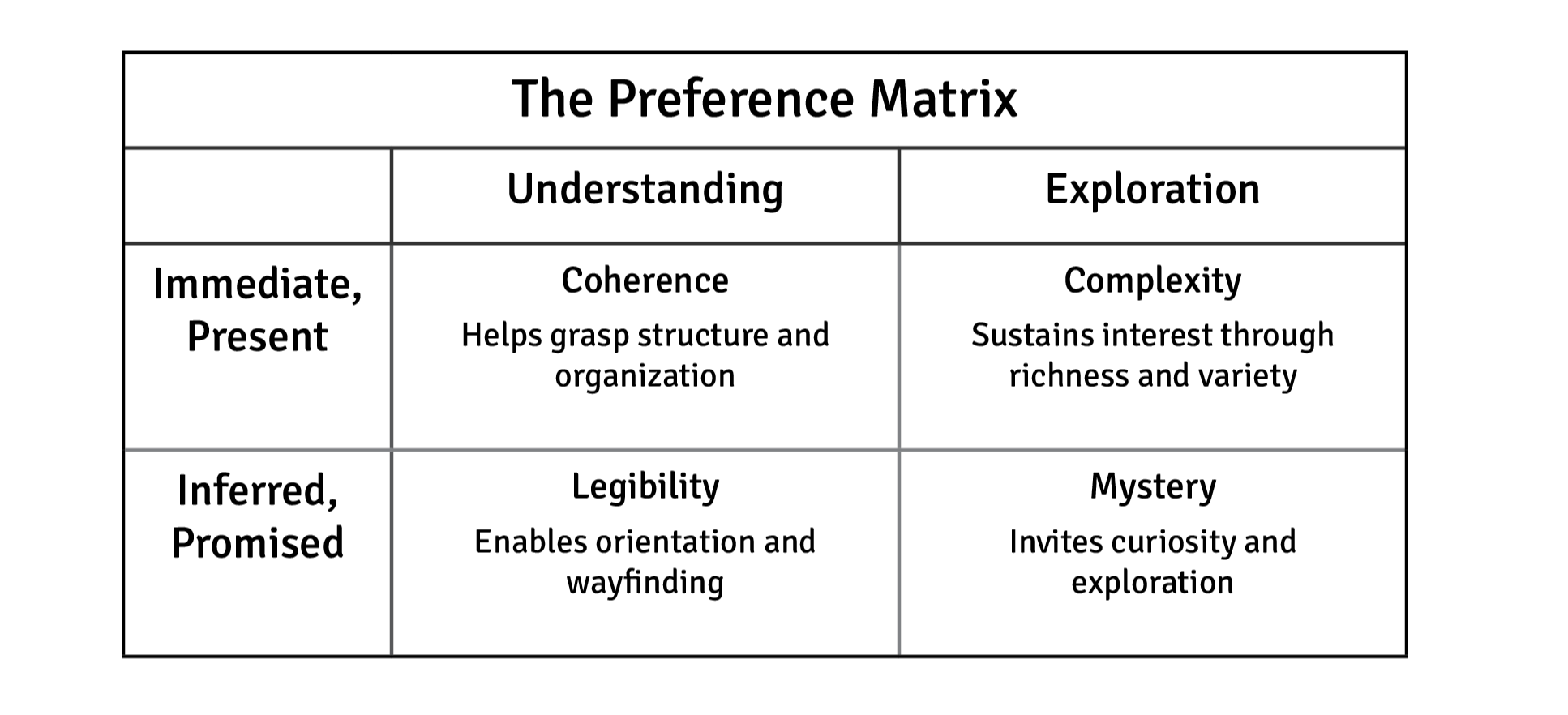
These insights led my partner, Stephen Kaplan, and me to create The Preference Matrix*, linking environmental preference to fundamental human needs for Understanding and Exploration (one of the three core principles of the SEE Framework). We identified four qualities that contribute to effectively functioning in our natural environments.
While individual scenes vary with respect to each of the four qualities, the Preference Matrix suggests that each quality plays an important part. Neither understanding nor exploration is sufficient without the other. Clarity in the moment is not enough if one has no sense of what is to come.
SEE and Preference
While the research began with pictures and landscapes, the Preference Matrix extends far beyond them. Our need to make sense of the world, while at the same time pursuing curiosity, applies as much to our physical surroundings as to the workplace, digital tools, and our social lives. Coherence and legibility help us understand where we are; complexity and mystery keep us engaged and motivated to explore.
What began as a study of scenic preference opened a decades-long groundswell of research and popular interest documenting a multitude of roles nature plays in human wellbeing. Furthermore, it opened a window into what helps people function effectively.
Far from being a whim, preferences are adaptive responses favoring environments where we can better make sense of things, continue learning, and act with confidence.
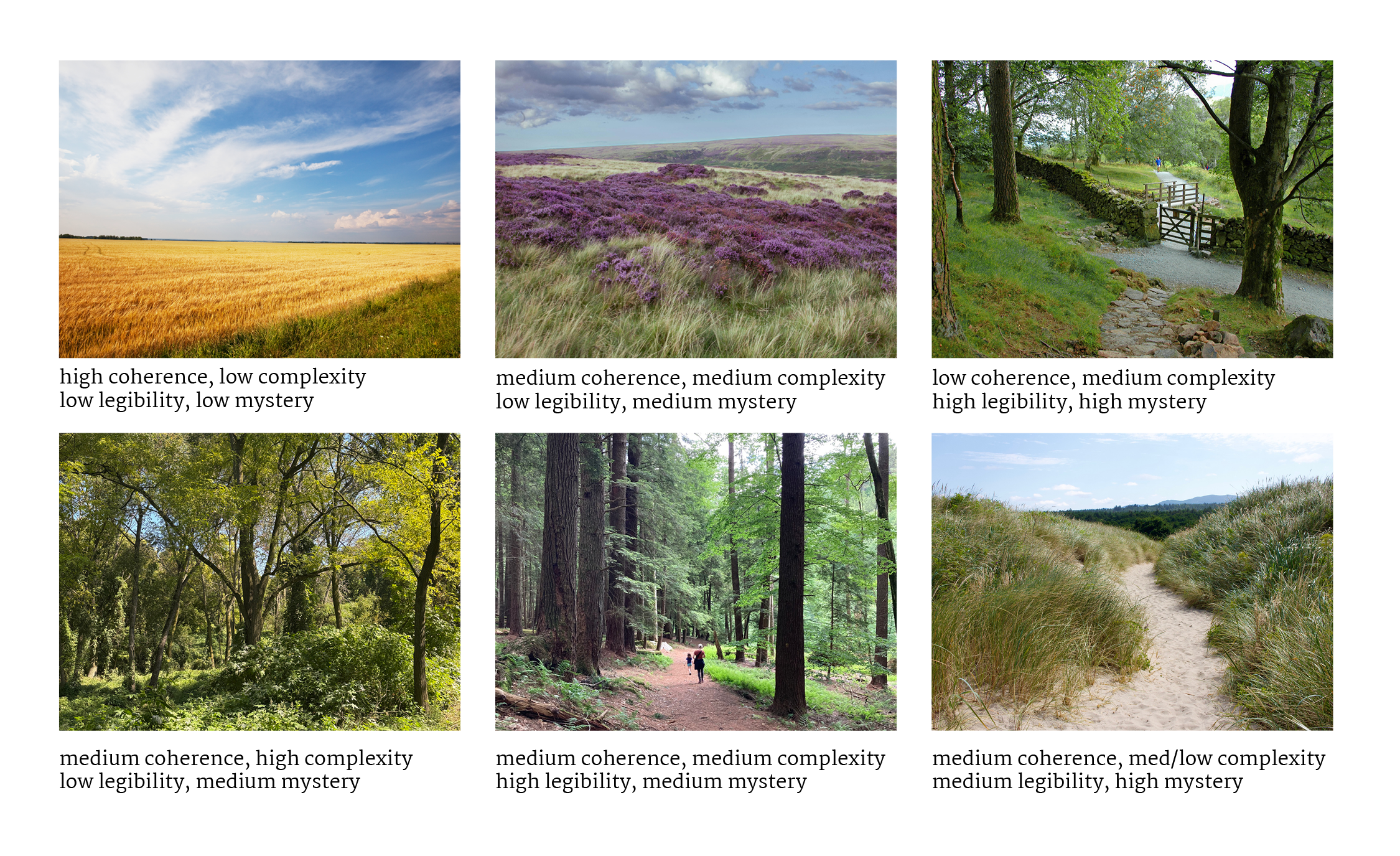
Image credits: Top Left to Right via Canva.com: Kamchatka, Alexandra Krikova for Pexels, Pam Crane for Pexels; Bottom row: Rachel Schad
Takealongs
Organization and structure aid coherence and legibility.
Variety and complexity sustain exploration.
Invitation to discover more – mystery – keeps us engaged.
The balance of clarity and richness is essential for effectiveness.
The SEE framework grew out of these research-based insights.
*Stephen Kaplan and Rachel Kaplan, the founders of reDirect and the spirit behind the SEE framework, spearheaded the environmental preference research program when they were faculty at the University of Michigan.