
See For Yourself
I am on a mission to visit the Barcelona art exhibitions on my list before peak tourist season makes them all but impossible to enjoy. The problem for me is not just the sheer number of visitors, but the way that so many museum goers these days seem more focused on checking the site off their to-do list than on experiencing the art.
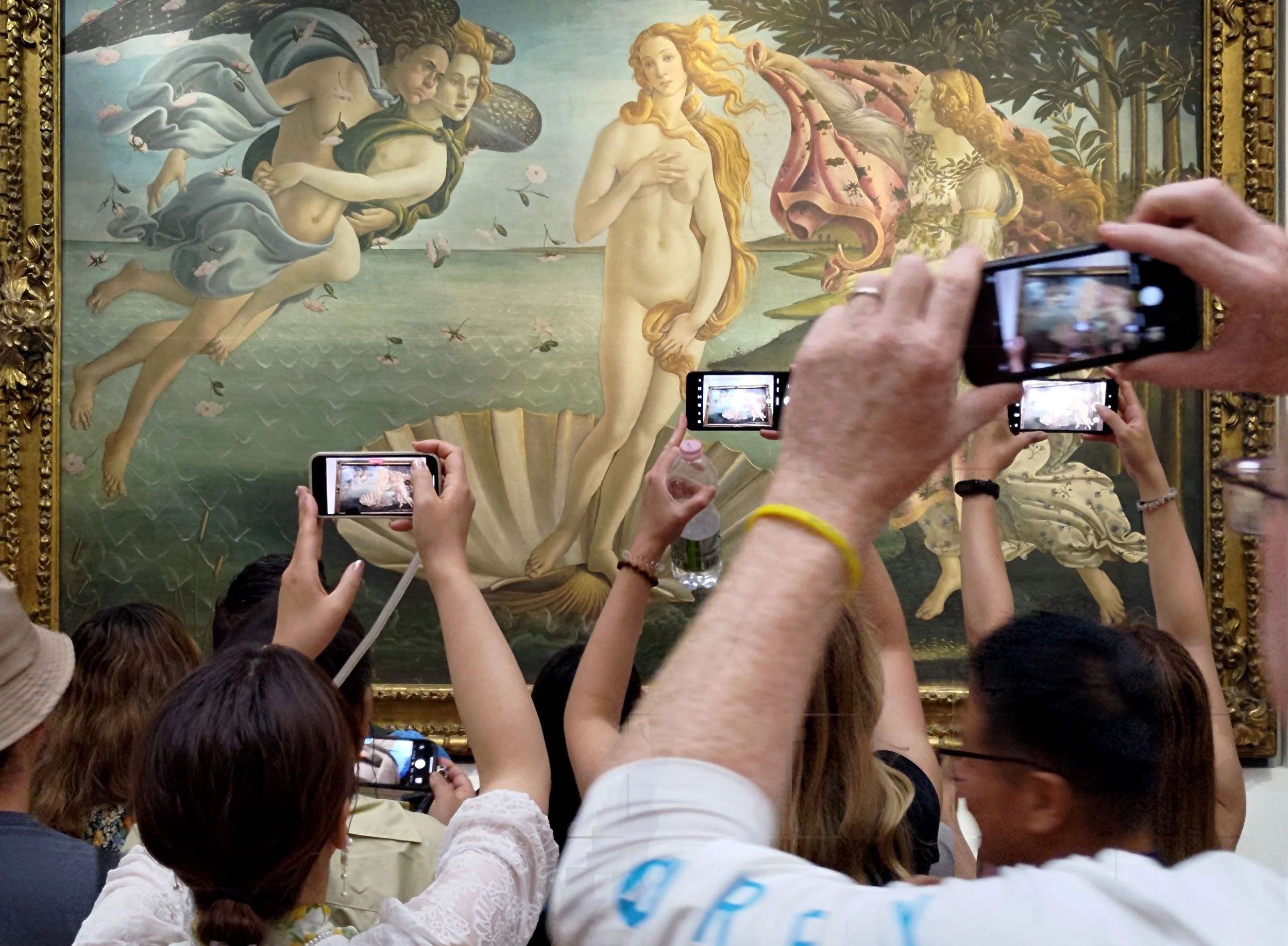
Photo: Anne KearneyMy visit last year to the Uffizi museum in Florence is a perfect example. The crowd moved through the space with as much attention as they probably scrolled through their newsfeeds. Artworks were consumed one after another with a quick look, a photo, and – the ultimate horror – a selfie with the artwork. Thousands of people left that day able to say that they had “done” the Uffizi, and with the images to prove it.
I suspect that most left with little else.
Why does this matter? I can sense you bracing for another hand-wringing rant about social media and the pace of modern life. But the problem I see has less to do with our diminished attention spans and more to do with how we know what we know – and what happens when we stop paying attention to the world around us.
There’s more to seeing than meets the eye
The brain, unlike those phones at the ends of selfie sticks that increasingly populate museums, does not simply record sensory information and file it away. Instead, it constantly works to parse and interpret what it sees by selectively attending, pattern-matching against existing knowledge, and even filling in details that aren’t there but that it expects to find. As the cognitive scientist and philosopher Daniel Dennett noted, we tend to see the world not as it is, but as we predict it to be.
Where do these predictions come from in the first place? In a circular twist of logic, they are built largely by observing and exploring the world as it is.
Watch an alert baby for a few minutes and you will see a world-class observer and explorer in action. To these unjaded infants, the whole buzzing world of sight, sound, texture, and taste is inherently interesting and worthy of exploration. They soak it all in, and their small brains work hard to learn what goes with what, what follows what, what matters, and what can be safely ignored. Little by little, they build up mental models of their world – what things are, how people behave, how systems work.
As we grow, these models do more and more of the perceptual heavy lifting. We recognize things at a glance. We predict what’s coming based on what we already know. We navigate confidently through the world rather than being perpetually adrift in a sea of raw sensation. It is an elegant and efficient system – one that most of the time serves us extremely well.
When shortcuts lead to short circuits
One of the consequences of learning to rely less on the world and more on our own mental models is that we tend to live increasingly in our own heads. And for animals whose evolutionary niche is seeking and using information, that growing distance from direct experience comes with challenges.
One of those challenges is keeping our mental models current. If we are to stay connected with an ever-changing world, we must continually test our mental models against reality and update them when needed. And this testing requires rich, direct, embodied engagement with the world as it is. It can be unsettling when our models are found wanting. But it is largely through this process that we grow, adapt, and deepen our understanding.
The problem is that it has become increasingly easy to avoid challenges to our mental models and to maintain them not through direct engagement with the world but on a diet of curated, algorithmically-filtered images and information. AI will only accelerate the trend of training our brains on a low-fidelity simulation of the world that is rife with errors and biases.
Without periodic updates grounded in reality, we risk what some have called “hardening of the categories” – a creeping rigidity that leaves us less observant, more resistant to new information, and increasingly out of step with the world.
Even more insidious, we risk confusing familiarity and recognition for a deeper understanding – giving us the comfortable illusion of competence without the substance to back it up.
And yet when given a choice between the easy satisfaction of sticking with and using existing models and the often uncomfortable work of engaging with something new or confusing, the brain often takes the easy way out.
Which brings me back to the Uffizi.
It is easy to understand why a visitor would pause briefly at Botticelli’s The Birth of Venus, snap a photo, and move on. Their brain is just doing its job – it has quickly recognized the famous pattern and declared “I’ve captured it, nothing more to see here.” It’s also easy to understand why that same visitor might glide past a piece that doesn’t capture their interest at first glance – their brain makes a quick calculation, decides there is nothing to learn, and goes on to the next painting.
But what I see when I look at these visitors is how much they are missing out on by allowing recognition and snap judgment to stand in for truly observing and exploring.
“Hardening of the categories causes art disease.”
The art of seeing
The ability to see through active observation rather than passive looking or reflexive recognition is a skill. And like all skills, it can be deliberately cultivated.
The art of seeing requires, first and foremost, slowing down. When we are in a rush or under pressure the brain tends to default to autopilot, falling back on existing mental models and cognitive shortcuts. Slowing down creates the conditions for something different – noticing what you didn’t expect, lingering on the new or puzzling, allowing a first impression to evolve into something more nuanced.
It also helps to pay attention to the brain’s eager “got it” signal and then intentionally push past it. In a museum, this might mean staying with an artwork long after you have recognized it, categorized it, or made a quick judgement about whether or not you like it. You might let your mind float beneath your critical train of thought and simply invite in whatever there is to see. Or you might engage more actively – paying attention to the details, noticing how it makes you feel, questioning why it was made or what it says to you.
And while museums are particularly good environments for this kind of practice, the opportunities are everywhere – a neighborhood walk, a social gathering, your own terrace or backyard. And, of course, we can expand our observation to our other senses – hearing, feeling, tasting what’s there. What matters most is the mindset you bring to the experience – an expansive awareness, a genuine curiosity, an openness to surprise, and a willingness to be wrong about what you thought you knew.
What deeper seeing unlocks
I started my Uffizi visit intending to look at the paintings. But I ended up observing the people – watching how they moved, noticing how they interacted with the artwork, wondering what had caught their attention. In doing so, I started drawing connections to other things that were on my mind – the way we so often filter our experiences through technology, how museum design affects behavior, what art can do for us if we let it.
One outcome of what I saw and thought – along with quite a bit of fermentation time – is this post.
That is what deep observation does. Observation is not just a pleasant pastime – it is the main way we build and expand the mental architecture through which we interpret everything else. It is what keeps our brains up-to-date, helps us connect ideas, and rewards us with moments of insight.
This matters beyond museums. The same observational skills that help us genuinely see an artwork are the ones that help us genuinely see other people — noticing what is actually there rather than what we expect, staying curious, being open to updating our minds. We could probably all use more practice.
The world is full of things worth seeing – let’s invite them in!