
Resources
Go deeper into the science of SEE with our collection of publications and research. More resources coming soon.

SEE Lens: Preference
Beauty is said to be in the eye of the beholder, but “beholders” (that’s all of us) make surprisingly consistent choices. Beneath individual tastes lie deep-rooted preferences that shape many of our choices and actions.
Beauty is said to be in the eye of the beholder, but “beholders” (that’s all of us) make surprisingly consistent choices. Beneath individual tastes lie deep-rooted preferences that shape many of our choices and actions.
Research on environmental preference offered surprising insights that turn out to be applicable far beyond environmental contexts. It’s hardly newsworthy anymore, but the first study showing that people consistently preferred scenes containing nature content appeared in 1969*. Such findings have since been confirmed across continents and cultures, with widely varying “nature” in rural, urban, and residential settings, and including contexts from schools to hospitals and even prisons. There is no question that people have a strong preference for “nature.”
In addition to documenting preference for nature content, the early research pointed to the role of spatial configuration. Scenes that were least liked involved either dense vegetation that obstructed the view or, at the opposite extreme, scenes with wide, undifferentiated expanses. While spatially dissimilar, both patterns suggest that it would be difficult to find one’s way in the setting, and perhaps even more difficult to find one’s way back. The preferred scenes, by contrast, offered visual access and cues suggesting how one could move through the space.
Preference, then, is about much more than beauty; it reflects our ability to function effectively—to make sense of our surroundings and anticipate what lies ahead.
These insights led my partner, Stephen Kaplan, and me to create The Preference Matrix*, linking environmental preference to fundamental human needs for Understanding and Exploration (one of the three core principles of the SEE Framework). We identified four qualities that contribute to effectively functioning in our natural environments.
While individual scenes vary with respect to each of the four qualities, the Preference Matrix suggests that each quality plays an important part. Neither understanding nor exploration is sufficient without the other. Clarity in the moment is not enough if one has no sense of what is to come.

SEE and Preference
While the research began with pictures and landscapes, the Preference Matrix extends far beyond them. Our need to make sense of the world, while at the same time pursuing curiosity, applies as much to our physical surroundings as to the workplace, digital tools, and our social lives. Coherence and legibility help us understand where we are; complexity and mystery keep us engaged and motivated to explore.
What began as a study of scenic preference opened a decades-long groundswell of research and popular interest documenting a multitude of roles nature plays in human wellbeing. Furthermore, it opened a window into what helps people function effectively.
Far from being a whim, preferences are adaptive responses favoring environments where we can better make sense of things, continue learning, and act with confidence.
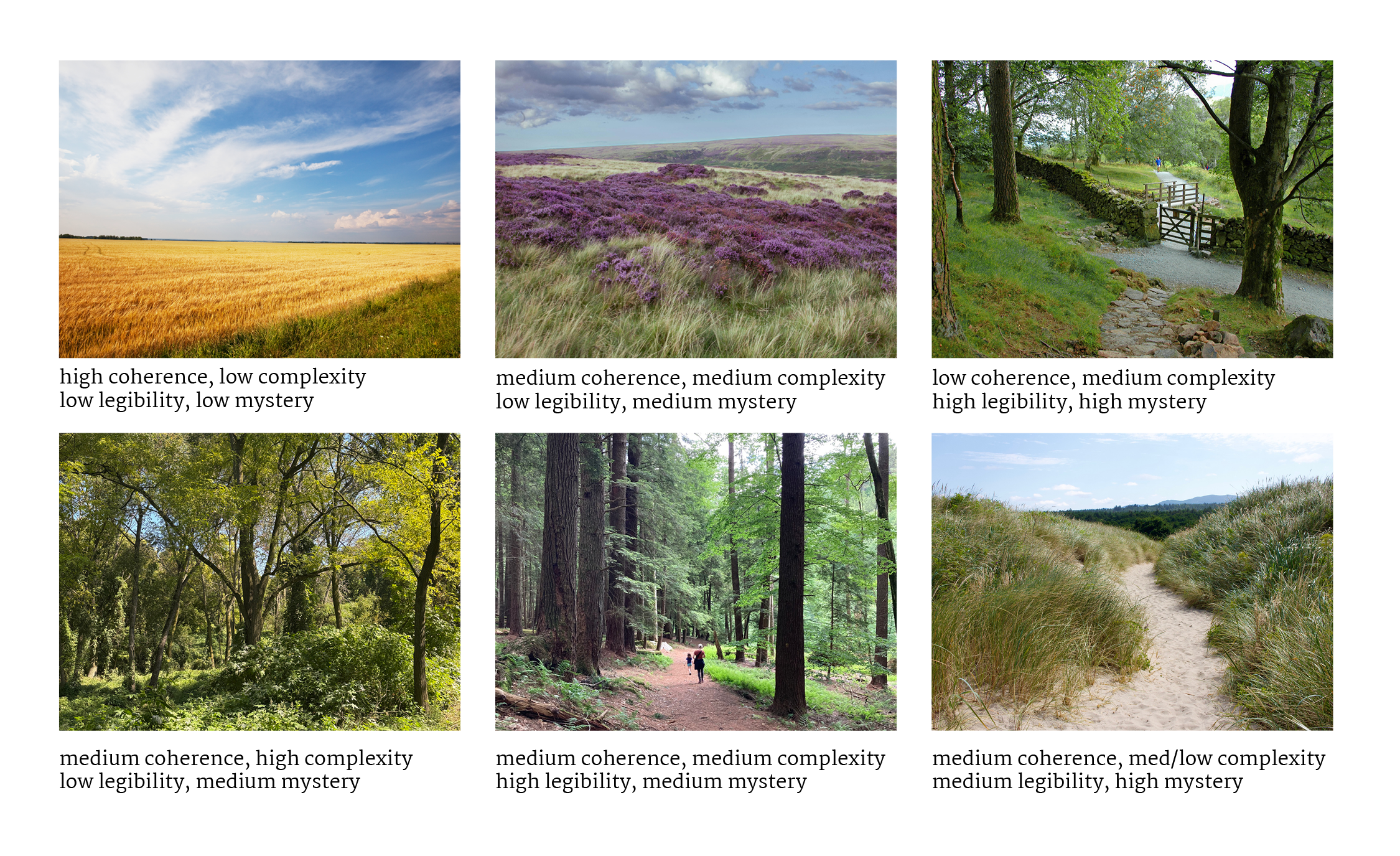
Image credits: Top Left to Right via Canva.com: Kamchatka, Alexandra Krikova for Pexels, Pam Crane for Pexels; Bottom row: Rachel Schad
Takealongs
Organization and structure aid coherence and legibility.
Variety and complexity sustain exploration.
Invitation to discover more – mystery – keeps us engaged.
The balance of clarity and richness is essential for effectiveness.
The SEE framework grew out of these research-based insights.
*Stephen Kaplan and Rachel Kaplan, the founders of reDirect and the spirit behind the SEE framework, spearheaded the environmental preference research program when they were faculty at the University of Michigan.

SEE Lens: Understanding and Exploration
You, too, were probably an annoying toddler. You did what most 3-year-olds do, but you didn’t know it. Nor did you mean to be annoying or realize that you kept asking the same question. Why… why…why???? You were simply on a necessary mission: making sense of the world around you. A mission that never ends.
You, too, were probably an annoying toddler. You did what most 3-year-olds do, but you didn’t know it. Nor did you mean to be annoying or realize that you kept asking the same question. You were simply on a necessary mission, like most other toddlers; a mission that never ends.
Illustration by Rachel Schad
Why? Why…why…why.. and more of the same! Three-year-olds famously and endlessly ask that simple question. They want a genuine answer, and they want it right then. The likely “reward” for an answer is another inquisitive why, now with respect to the new information.
Why do we keep answering these questions? You see,‘why?’ isn’t just a toddler question! The underlying reason for the question is no different for any of us, across demographic categories, and throughout our lifespans. Providing “useful answers” is an unending challenge. Why do we persist in asking the question when we so often don’t get a useful answer? We may not even remember why we asked by the time an answer emerges. Why do we settle for –or even provide – answers that are misleading, untrue, or deceptive? Why are there so many contradictory answers to the same question? Why…why…why…
In the jargon of the SEE framework (Supportive Environments for Effectiveness), the answer to these questions is Understanding and Exploration. The three-year-old is trying to make sense of (or understand) everything and anything. That requires seeking answers, i.e., exploring possibilities, to resolve the quest. As adults, we still need to make sense of mundane momentary issues swirling around us, as well as the existential dilemmas that cast shadows on tomorrow. Neither belief nor disbelief resolves the desire to understand, so we continue to explore more satisfying solutions.
Portable Gizmos
Fortunately, even before we can ask our first “why” question, we have already begun the process of wondering; in other words, we are born motivated to seek answers! For 300,000 years, give or take a few, we humans have arrived with fabulous, tiny portable computers that require no upgrades or passwords. They come ready to take on a huge range of situations and tasks, incorporate new material (aka information), and pivot if circumstances call for a change of tactics. Not only that, but our gizmos include mechanisms for retrieving stored information on demand.
What an awesome ancient machine! Life nowadays bears little resemblance to 300,000 years ago, yet the device that enabled our ancestors to explore their surroundings and enhance understanding is still the core tool for exploration and understanding today. Our gizmos – our brains – have always depended on a diet of information.
Before any of us could sit, stand or toddle (or ask annoying ‘why’ questions) we were surrounded by a huge amount of information from our physical, temporal, and social environments. A great deal of the information is repetitive – light patterns, sounds, shapes, people, admonitions. An infant’s brain may not be aware of such minutiae, but it is tuned in to information and to its repetitions. OK, repetition may amuse infants, but wouldn’t the rest of us find it boring, maybe even annoying like the repeated why questions?
Yes and no. Repetition is powerful. That’s how we all learned to identify shapes, eventually recognized that the person smiling at us will attend to our tears, acquired our “native tongue,” and learned to read. Where would advertising be without repetition? We hear a jingle often enough and know what to expect; we see a logo often enough and the “right” associations come to mind. In other words, repetitions build familiarity and create predictability!
Wow! By experiencing similar patterns many times, repetition allows our awesome gizmos to predict or anticipate. But what if the repetition-anticipation cycle fails? Sometimes—as with humor – those might even be planned “failures” or welcome surprises. More often, however, when the expected next step doesn’t happen, the result is confusion and frustration. In other words, the failure of prediction can be costly, leading to chaos, helplessness, and anger.

©Daniel Brumley on Canva.com
Take-alongs
The why question is a multilayered revelation. With toddlers it expresses an innocent curiosity. Innocence may decline over time, but curiosity is a lifelong penchant. Humans are seekers; we are hardwired to explore and venture. That process can enhance understanding, i.e., the ability to make sense of a situation, task, or relationship. Understanding, however, often leads to next questions and more exploration. Further exploration is even more likely if the process fails to enhance understanding!
All of this points to us humans as restless seekers torn between the familiar and the next quest, dependent on prediction and yearning for clarity, in a world of unending information. We are motivated to seek answers, are easily provoked by confusion, and dislike boredom. Our ancestors thousands of years ago could have said the same thing, but now it all seems accelerated and compounded. Did children 300,00 years ago throw temper tantrums?
Consider how often we are faced with these predicaments – sometimes of our own making:
Needed information unavailable?
Unanticipated consequences of creating uncertainty?
Resentment when policies or procedures are altered with no explanation or warning?
Finding a new environment uncomforting even if we feel safe?
“Understanding and exploration” can provide a useful framework to deal with our own and other people’s seemingly erratic, or unreasonable, behavior. A handful of concepts have a multitude of ramifying implications:
Information is the lifeblood of our individual and social existence. It fosters good and encompasses bad; we love and hate it; horde and waste it, and we can’t survive without it.
Uncertainty is inescapable and often motivating. It can foster adventure as well as malaise.
Predictability partners with uncertainty. Unpredictability can be adventurous or devastating.
Familiarity builds predictability; it helps make sense but can also generate boredom.
Clarity is easier to appreciate when it is absent!

SEE Lens: Familiarity (and Antidotes)
Familiarity, like the air we breathe, gets little notice. It hides in plain sight, creating our vital, intertwined structures (aka mental models), which are at the core of everything we do and care about. The mental models of those with whom we want to, or need to, communicate are also invisible to us. That often leads to inadvertent confusion, miscommunication, and missed opportunities.
By the time we set off for first grade, we already knew a staggering amount –how to talk, make choices, tell stories, complain, get dressed. We didn’t know how we learned all this, or even that we knew it. It was just a part of us, and we assumed others were no different.
You already knew all that. In other words, you were familiar with it. Familiarity is an inevitable part of our existence and easily taken for granted. We depend on it and strive for it. So why the parenthetical “antidotes” in the title? Because we also bemoan familiarity when it leads to boredom. More importantly, familiarity can blind us; we often don’t realize what we lose when we acquire it.
Let’s unpack these claims.
Depending on Familiarity
It is easy to take familiarity for granted … until we lack it. That happens quite often! Can’t find something where you’re sure you put it; sudden glitches on your trusted devices; getting to your destination, but the expected conditions have changed; someone you know well acts strangely, or maybe you act strangely… Our cognitive clarity also relies on the predictability of sequences. Why isn’t Ctrl+Alt+Delete behaving as it should? Confusion is unlikely to be on our wish list.

©eclipse_images from Getty Images Signature at Canva.com
Striving for Familiarity
Much of our familiarity, especially in our earliest days and years, came without our conscious efforts. It was built from repetition—lots of it! There were repetitive sound patterns, shapes, objects, locations, foods, and specific people. There were also multitudes of repeating sequences, including responses to our actions. We are hard-wired to learn from repetition, incorporating variations as we acquire our knowledge.
Individually and globally, we also have substantial investment in gaining familiarity through conscious effort. Formal and informal education, coaching, and training are all about that -- concerted efforts for gaining familiarity. We rely on a vast array of expertise (others’ and our own) for answers to endless urgencies and puzzles.
Familiarity is the stuff of our memory, on the tip of our tongue, and the basis for our decisions. It is not surprising that we are biased for the familiar given how much it guides us.
Bemoaning Familiarity
Although familiarity is essential and inescapable, there are times when it breeds contempt. Perhaps practice makes perfect, but perfection may not be worth the effort. We greet others with “what’s new,” not “what’s same old.” Grandpa’s (or anyone’s) beloved, totally predictable tales can be hard to take. Repetition can be annoying. Worse yet, it can be distorting. That’s where antidotes come in.
Antidotes
Boredom is potentially a genuine drawback of familiarity. However, some other consequences of familiarity may be more consequential. Over time, with increased repetitions of objects, circumstances, or anything else, recognition becomes easier and faster, making new situations feel simpler and more comfortable. These changes are desirable and useful. However, they also change the way we “see” and “act.” Such transformations, in turn, often lead to complications– or even disdain – in dealing with people whose experiences differ from ours. That may be overly dramatic since no one shares all our experiences; the differences, however, can have dramatic implications, exacerbating the differences between individuals or groups differing in background or outlook.
Pattern Recognition and Categorization
Starting in infancy, we learn to recognize recurring patterns. We also learn names for these patterns (spoon, finger, dog, mom, dad.) We learn categories – cat and dog are in a different category from spoon or play. With vast familiarity, we automatically apply such categorizations both quickly and confidently.
Think about confronting a large pile of laundry you just removed from the dryer. Having a great deal of experience with such situations, you are likely to sort the pile in terms of similar objects (e.g., T-shirts, pants, socks, towels). It’s a quick, “automatic” task, but haste can lead to placing an item in the wrong pile.
That’s true for any area of expertise. We learn to see patterns and identify pertinent categories, not because of magical ability but from a huge amount of repetition. The pattern recognition becomes automatic and rapid; rapidity leads to confident decisions. Jumping to conclusions is a by-product of extensive familiarity. Sometimes there are major costs to such hastiness.
Communication Hurdles
When someone doesn’t understand something that’s “obvious,” it’s easy to forget that the same something wasn’t always obvious to us. Similarly, the assurance that a task is “really easy” wasn’t very convincing when we were given the same advice.
Communication depends on shared familiarity, and falters when it doesn’t align.
Familiarity is inescapable and indispensable. Extensive repetition is the basis of expertise, and as our expertise grows, we often encounter communication hurdles with those less knowledgeable. There are ways to deal with the implicit imbalance (if we recognize it), but, unfortunately, we often ignore the “others” who are affected. They are the people who might complain about not being respected, appreciated, consulted, “heard,” or “seen.” Sometimes we are those people. Other times we are the ones who let “I hear you” substitute for listening.
Regardless of our expertise, feedback can be beneficial; however, making the effort to provide it takes effort and intention. Feedback can help unmask potential mismatches between our differing ways of “seeing.”
Collaboration takes feedback to another level. It can take many forms, all providing opportunities to gain from others’ perspective.
Rather than putting ourselves in someone else’s shoes, we can all benefit by inviting the people wearing their own shoes into the conversation.
SEE and Takealongs
Familiarity, like the air we breathe, gets little notice. It hides in plain sight, creating our vital, intertwined structures (aka mental models), which are at the core of everything we do and care about. The mental models of those with whom we want to, or need to, communicate are also invisible to us. That often leads to inadvertent confusion, miscommunication, and missed opportunities.
By contrast, meaningful action need not be inadvertent or invisible! It encompasses countless remedies for addressing communication hurdles and can take advantage of our differences. We have mental models for taking such actions as well. Active listening, feedback, and collaboration can go a long way toward enabling supportive environments.
That, however, draws on our bandwidth, requiring effort and intentionality. And yet, the outcomes can be well worth the investment.

SEE Lens: Listening
Listening is a multimodal enigma. We, humans, have done it for millennia, and individually depend on it our entire lives. We are unlikely to have thought about how fundamental listening is to our understanding, explorations, and the ways we interact with our worlds. It is a key source of input to our knowledge and awareness, as well as key to the roles we play in other people’s lives.
Listening is a multimodal enigma. We, humans, have done it for millennia, and individually depend on it our entire lives. We are unlikely to have thought about how fundamental listening is to our understanding, explorations, and the ways we interact with our worlds. It is a key source of input to our knowledge and awareness, as well as key to the roles we play in other people’s lives.
Despite all that, our listening capability is surprisingly deficient. We complain about not being heard but, even with good intentions, we are often poor listeners. We also are unlikely to consider the negative impacts of our efforts on the listening of intended recipients.
Life goes on—we depend on communicating, complaining when it doesn’t work adequately, and satisfice. Can SEE (Supportive Environments for Effectiveness) provide insights to help understand and improve the situation?
Listening to Myself
It wasn’t intended to be a small experiment. Pedaling on the stationary bike, Celtic tunes playing to motivate the cycling, seemed like a good time for trying to listen to myself. My low budget “Folding upright bike with pulse” has never been folded up and I don’t care to track my pulse, but I appreciate having the speed, distance, and odometer readings. My focus, however, was on listening and how to rewrite a previous version of this piece.
I kept up the pedaling, but the listening agenda required frequent rekindling! The speed and distance readouts provided uninvited evidence that mind wandering has physiological manifestations. The combination of numbers on the odometer led to amusements about their numeric properties. The time readout made me wonder whether I would meet my undeclared guidelines. My mind wandered in various directions between trips back to the intended topic. Listening to myself turns out to be much like listening to others: intentions are usurped, the mind’s invisible agenda takes precedence.

©The Everett Collection via Canva.com
The SEE Trio and Listening
Clearly, listening and attention are closely related. Both have several variations, including:
Low-key, low-return listening when we nod and say “aha,” with little attempt to engage; these common occurrences place minimal demand on attention.
“Really” listening, which demands real effort. “Paying” attention provides an apt metaphor as such concerted attention has costs: it dwindles (fatigues) with use, potentially leading to undesirable consequences if not permitted to be replenished.
“Captivating” attention: Consider situations that require no intent but compel our attention, such as a beloved musical piece or bird sounds. Listening in such contexts comes naturally and effortlessly.
In the SEE framework these attention-based variations of listening are related to the Bandwidth category. They differ in the effort they require and, consequently, given that effort is finite, in the need for replenishment or restoration.
Implicit in this discussion is that listening encompasses much more than sound or vocal expression. Listening to ourselves is likely voiceless. Even listening to a speaker incorporates nonverbal qualities that enable interpreting and comprehending the intended message. Put another way, listening entails efforts to make sense, to Understand, which is another of the three core qualities of the SEE framework. Of course, that doesn’t mean that listening assures or even enhances understanding – we have all experienced attentive, active listening that led to enhanced confusion rather than clarity. Listening to the daily news offers ready examples.
The third of the SEE trio, Meaningful Engagement, also bears strong ties to listening. Listening is crucial for conveying trust and respect, providing reassurance, and expressing appreciation – all fundamental features of meaningful engagement. Listening empathetically is foundational to conveying compassion and communicating connection.
Synergy and Mental Models
Just as our bodies need water, proteins, and sleep, each of the SEE trio (Bandwidth, Meaningful engagement, and Understanding) is essential for our effectiveness. It is also true for both these sets that their impacts derive invisibly from their synergy—the ways they function interactively.
Beginning long before we know it, we engage in a continually evolving mega DIY project that is awesome in its capacity and remarkable in its retrieval capabilities. While curiosity occasionally leads us down rabbit holes, much more often, it propels innumerable explorations that become the basis of how we see the world – aka our mental models. Our mental models guide our actions, emotions, and just about everything else. They come with us wherever we go; we couldn’t get to wherever that is, without them.
We are generally oblivious to the attentional costs of our mental activity – exhaustion often sneaks up on us, and we only recognize the tradeoff in hindsight. Our attentional capacity may be depleting, but the sense of making a difference, the excitement of new insights, and the eagerness to continue the exploration override the realization of mental fatigue. Indeed, it’s not unusual that we disregard the realities of mental fatigue. What is often labeled ‘burnout’ may not necessitate dire measures; attending to mental fatigue, however, does call for a dose of the effortless kind of attention.
The SEE Lens
We humans share many characteristics: we are curious creatures, constantly trading information; we do better with a clear head than with confusion and a sense of helplessness; we depend on others, and they depend on us. Despite years of experience with these qualities, we are surprisingly inept at bringing out the best in ourselves and others. The SEE framework doesn’t offer cures or surefire solutions; it does, however, provide some directions and considerations that are broadly adaptable.
Listening is essential for making a difference. It is a vital tool for meaningful engagement which, in turn, enhances understanding through exploration. Exploring leads us to try out solutions to challenges and dilemmas. Even small steps can make big differences. As we try out solutions, our exploration can lead to attentional fatigue, leading to new ways to replenish our attentional resources. And so the exploration cycle goes on!
A word of caution now: While small steps can and do indeed make big differences, they can’t preclude differences that are hateful, harmful, and inhumane. We are living with daily examples of hatred, begetting more hatred, and personal ambitions usurping any sense of moral obligation. It doesn’t take SEE to know that permitting a sense of doom is a sure path to deeper doom. A SEE lens can shine a light on some of the underlying challenges but is ineffectual at solving these intertwined realities.
Small steps are vital for positive differences. Life is comprised of small steps taken individually, and with others, at home, work, and by communities. Small steps are the path to increasing understanding, regaining bandwidth, maintaining civility, and inspiring insightful outcomes.
Take-alongs
Genuine listening is a powerful, life-embracing tool. Its absence undermines civility, meaningfulness, and joy. Genuine listening is also demanding. What it demands is attention—also a powerful, life-embracing tool! Attention is a subtly fragile resource; its decline is unwittingly overlooked as the trigger for irritability and poor judgment.
Alas, there is yet another predicament bearing subtle, invisible, and unintentional ramifications. It concerns the ways each of us impacts other people’s attentional capacity. We like to hold forth, oblivious to whether the intended recipients find the details pertinent, useful, or even understandable. We generate noise that is hard for others to avoid. We dwell in negativity. We emit signals that make it clear that we are not really listening.
Life depends on communicating, but that doesn’t mean we are good at it. A helpful antidote involves looking inward: listening to ourselves, what pulls us down, how do we recalibrate? Being thoughtful about how others feel and asking for feedback are powerful forms of listening. It’s often worth the effort.
SEE Lens: Bringing Out the Best
How can we bring out the best in ourselves, and others? The SEE Framework can provide some insight. One of SEE’s key tenets, Meaningful Engagement, proposes that people need 1) to feel they make a difference, and 2) to foster a sense of belonging through relationships grounded in mutual trust and respect.
This essay by reDirect’s co-founder, Rachel Kaplan, looks at how each element of the SEE framework intersects with Meaningful Engagement and talks about the important roles that participation, feedback, and small experiments play.
This blog is a companion resource to the video titled “Bringing Out the Best.”
Take a minute to ponder some lesser things that annoy you. Does your list include any of these?
People (e.g., co-workers, your boss, family members) say they’ll do something, but don’t.
When people know you want to be left alone at some particular time, but interrupt.
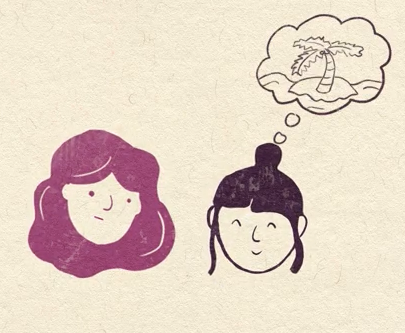
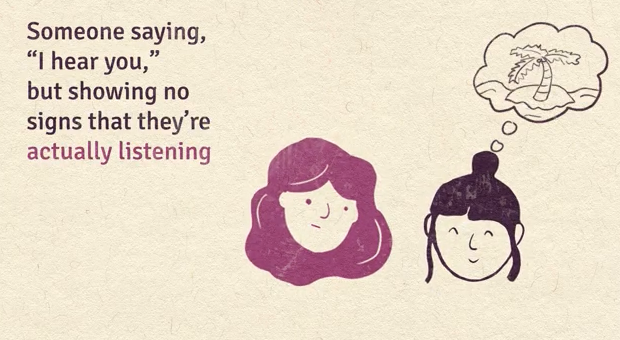
People say, “I hear you,” but there’s no sign they are listening.
In fact, there are no signs that your existence makes much difference.
Alternatively, someone’s thoughtful efforts to show appreciation backfire because they were so poorly matched with your preferences.
It’s likely you have had such annoyances more than once, as well as many others that can dampen joy.
Now flip the scenario. Take a minute to ponder whether you have been the source:
The one who said you’d do something and didn’t follow through,
Who couldn’t resist interrupting,
Who “listened” without hearing what was said,
Ignored co-workers or others for whom even a smile would be a welcome greeting,
Or, the well-intentioned person who failed to really consider the recipient’s needs or preferences?
It’s likely you too have had such experiences more than once.
Our lives are embedded in inconsistencies. Unpredictability greets our hope for certainty, while more of the same beckons when change is what we crave. Without much awareness, we live in a world of asymmetries. Yes, we often violate the Golden Rule (Treat others as you would like to be treated). We want to “be heard” but don’t actively listen; we complain about “not being seen,” but don’t acknowledge when we are. Our sensitivity to our own hurts is much more fine-tuned than our awareness of others’ needs.
How the SEE Framework Fits In
Helping to bring out the best in others is both complex and rich in rewards, not only for those “others” but also for ourselves. Meaningful engagement, one of the three key tenets of the SEE (Supportive Environments for Effectiveness) framework, focuses on the importance of making a difference, building trust, and being respected—all germane components of fostering our common humanity. It’s easy enough to understand the words “meaningful” and “engagement,”; “doing it,” however, is more challenging. “Meaningful” is the hard part. It requires intentionality. It takes concerted attention.
We know from SEE’s Bandwidth tenet that attention is a precious, finite resource that demands effort, the very effort we are often reluctant to invest. The third SEE tenet, Understanding, is also integrally linked with engagement. To be useful, engagement requires understanding of the circumstances, or what SEE frames as environments, that comprise the situation at hand. These are likely to include time parameters (past, present, and future dimensions that impact any decision), social considerations, policies and practices, economic realities, and the physical space impacted by where the action takes place.
What then does SEE offer to make meaningful engagement more likely to happen? Two key approaches are participation and small experiments. Each can have its downsides, but the upsides far outweigh them. Each also has many variants, appropriate occasions, and broad applicability. And they play well with each other.
Participation
One effective way to make someone realize that they are making a difference is a compliment. It can easily convey that a person (or group) is valued, respected, noticed, and appreciated. Occasionally, paying a compliment opens the door for further conversation and exploration of mutual interest or concerns.
Even a simple “what do you think?” question can offer a chance for participation – with a cautionary addition. The “meaningful” dimension is lost if the effort is disingenuous. “What do you think” efforts are often packaged as surveys. Here the caveat is that effective surveys are not as straightforward as many assume. However, a great deal of helpful information about crafting surveys, sampling, and increasing the likelihood of responses is available. Perhaps less emphasized is the need to anticipate data management so it won’t be cumbersome or overwhelming, ultimately leading to abandoning the effort and violating the trust of those who honored the request for answers.
Feedback constitutes another major category of participatory opportunities. For these too, especially in the organizational context, there is a wealth of information, including so many acronyms for feedback models (e.g., SBI, STAR, EEC, IDEA, DESC, CEDAR, and BOOST) that a super-acronym might help sort them out. Feedback is often institutionalized in the form of performance reviews, typically embedded in a hierarchical structure and sought in a top-down direction (i.e., “superior” to “subordinate”). A uni-directional approach and hierarchical structure, however, seems antithetical to bringing out the best in all participants; meaningful engagement is more likely for both the givers and recipients if feedback is shared in all directions – “up,” “down,” and “sideways.”
A subtext throughout this cursory discussion of participation is that there is no failsafe magical wand that guarantees desired outcomes. Perhaps some sophisticated apps (e.g., project management and collaboration tools) have magical powers. It’s more likely that real people in real time with variable tolerance for frustration and experience need to help with damage control – in other words, be meaningfully engaged. Such situations, including making collaborations workable and beneficial, are ideal for small experiments!
Small Experiments
Why don’t our well-intended efforts work? Why did that feedback backfire? Why did people skip many questions on a survey? Why is meaningful engagement so challenging? Why didn’t anyone read that blog… or did they?
Why not try to figure out answers to such questions? Small experiments are intended to do that, with this caveat: the answers won’t be definitive. The truth is that definitive answers are illusive; not seeking answers, however, is not more definitive! What makes small experiments “experiments,” is that they seek answers, enhancing our understanding of a specific quest. The reason to keep them small is to resist overwhelm. So, there is a delicate balance between pursuing our curiosity, and utter frustration. If all goes well, the process will be sufficiently useful … and enjoyable … to sustain curiosity and desire to tackle the next question.
A Few Small Experiments by Past Grantees
While small experiments can be solo activities, they offer a strong tool for participatory situations. reDirect’s SEE Learning Cohorts have effectively carried out small experiments with several dozen nonprofits. The applications have spanned topics including:
Improving communication and strengthening connections among dedicated volunteers
Organization: Wheelchair Ramp Accessibility Program (WRAP)
Helping staff feel more connected and supported through formalized working groups
The Community Resource Center
Organization: Habitat for Humanity of Metro Denver
Bringing Out the Best: Fostering Our Common Humanity Through Meaningful Engagement
Why is the Golden Rule so hard to follow? How is it relevant to our work and accomplishing our goals?
We dive into these questions as we explore the concept of Meaningful Engagement, which proposes that people need 1) to feel they make a difference, and 2) to foster a sense of belonging through relationships grounded in mutual trust and respect. It's one of the three key tenets of the Supportive Environments for Effectiveness (SEE) framework.
December 10th, 2025.

Small Experiments - Cultivating a Mindset
Overwhelmed by big challenges at your nonprofit? There's a better way to tackle them than starting a new massive overhaul of processes every 6 weeks. reDirect's Small Experiments approach offers manageable changes that help you learn and adapt—low risk, quick to implement, and focused on learning rather than perfection. The process is simple, and replicable. Take a look at this video to learn more about how your organization can benefit from implementing a Small Experiment Mindset™.
October 16th, 2025.

Environments Matter: Change Your Environment, Change Your Results
What if the reason you’re stuck isn’t a lack of discipline, but the spaces you live in? Anne Kearney’s experience shows how subtle cues, community habits, and everyday setups can either push you toward your goals or quietly steer you off track. Check out this video to learn about the invisible forces shaping your daily life choices.
August 13th, 2025.

The Small Experiment: Achieving More With Less
What makes a ‘small experiment’ small? How does it differ from more traditional, research experiments? Rachel Kaplan explores these ideas in her 1996 paper, prepared for EDRA (the Environmental Design Research Association).
January 15, 1996

SEE Differently: Improve Your Volunteer Program
SEE Coaches Traci Lato-Smith and Kayla Paulson join Nicole R. Smith on her podcast, From the Suggestion Box, to discuss their experience with the SEE framework, volunteer programs, nonprofit operations, and more. Click the link below to listen on Spotify.
May 26, 2023.

What is “SEE”?
Do you ever feel unproductive or burned-out, or struggle to keep up with endless meetings, messages, and emails? The Supportive Environments for Effectiveness (SEE) framework proposes that our environments have a powerful impact on our behavior, and can either hinder or support our success. Rather than focusing on personal shortcomings, SEE helps us identify environmental challenges and design solutions that better support our needs.
April 18, 2023.

The Expertise Dilemma
How can we overcome the challenges that arise when communicating complex information between experts and non-experts? Watch this video for three lessons on how SEE can help you address these barriers in your own everyday interactions.
April 18, 2023.

Your Brain on Birdsongs
Environmental psychologist and reDirect board member Avik Basu shares insights on the SEE framework and Attention Restoration Theory (ART) as a guest speaker on the podcast The Bird Who Made Me Happy. Listen to the full episode (Your Brain on Birdsongs) to learn more about why our attention fatigues, and how nature can help.
December 20, 2022.

Shared Understanding
How might differences in our mental models influence our ability to communicate with one another? Watch the full video to learn about tips that can help you effectively communicate to reach a point of shared understanding.
December 21, 2022.
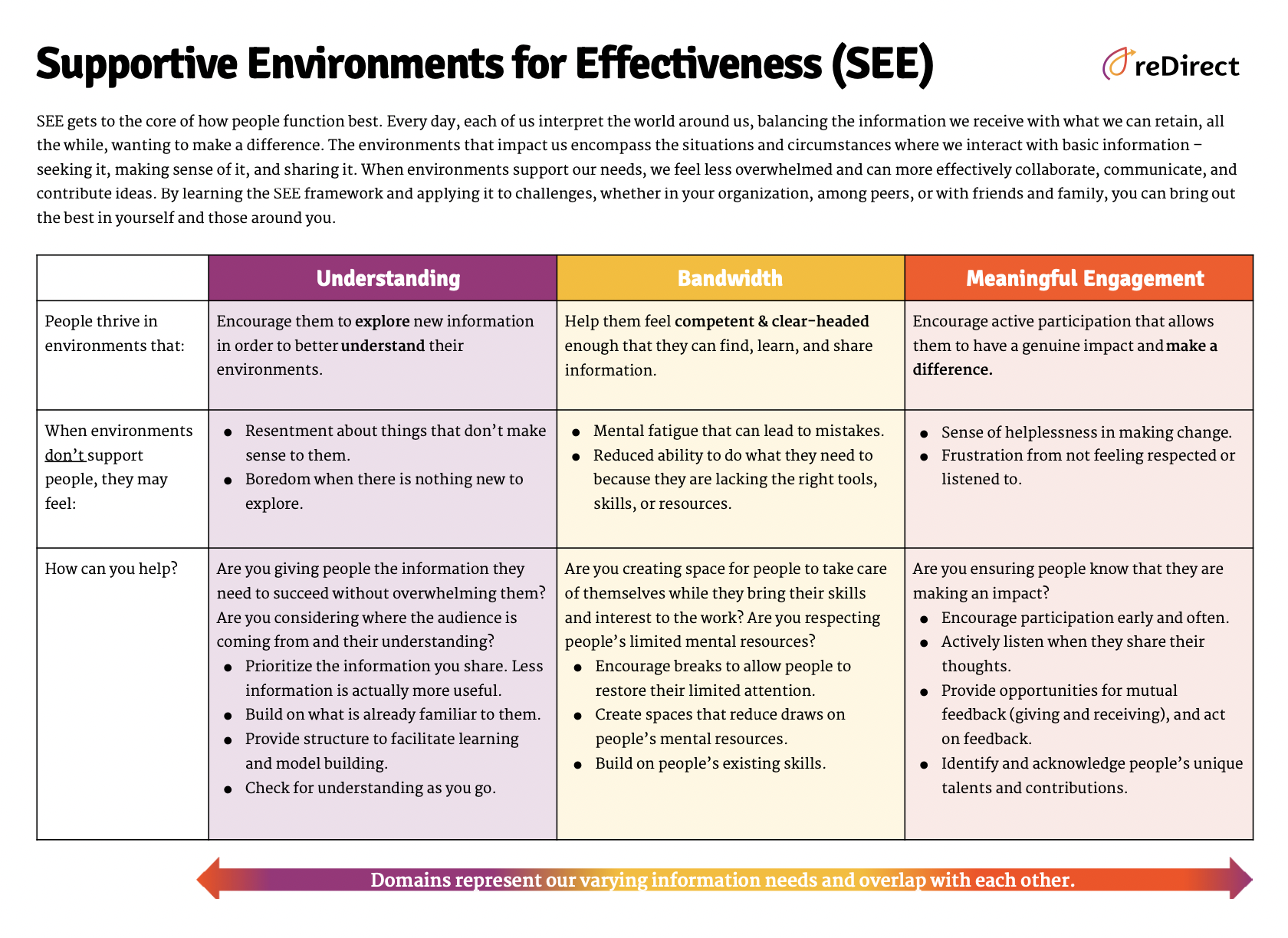
SEE Overview
A short handout from the reDirect team that gives a high-level overview of the SEE framework and questions we can ask ourselves to better leverage it.
November 30th, 2022.
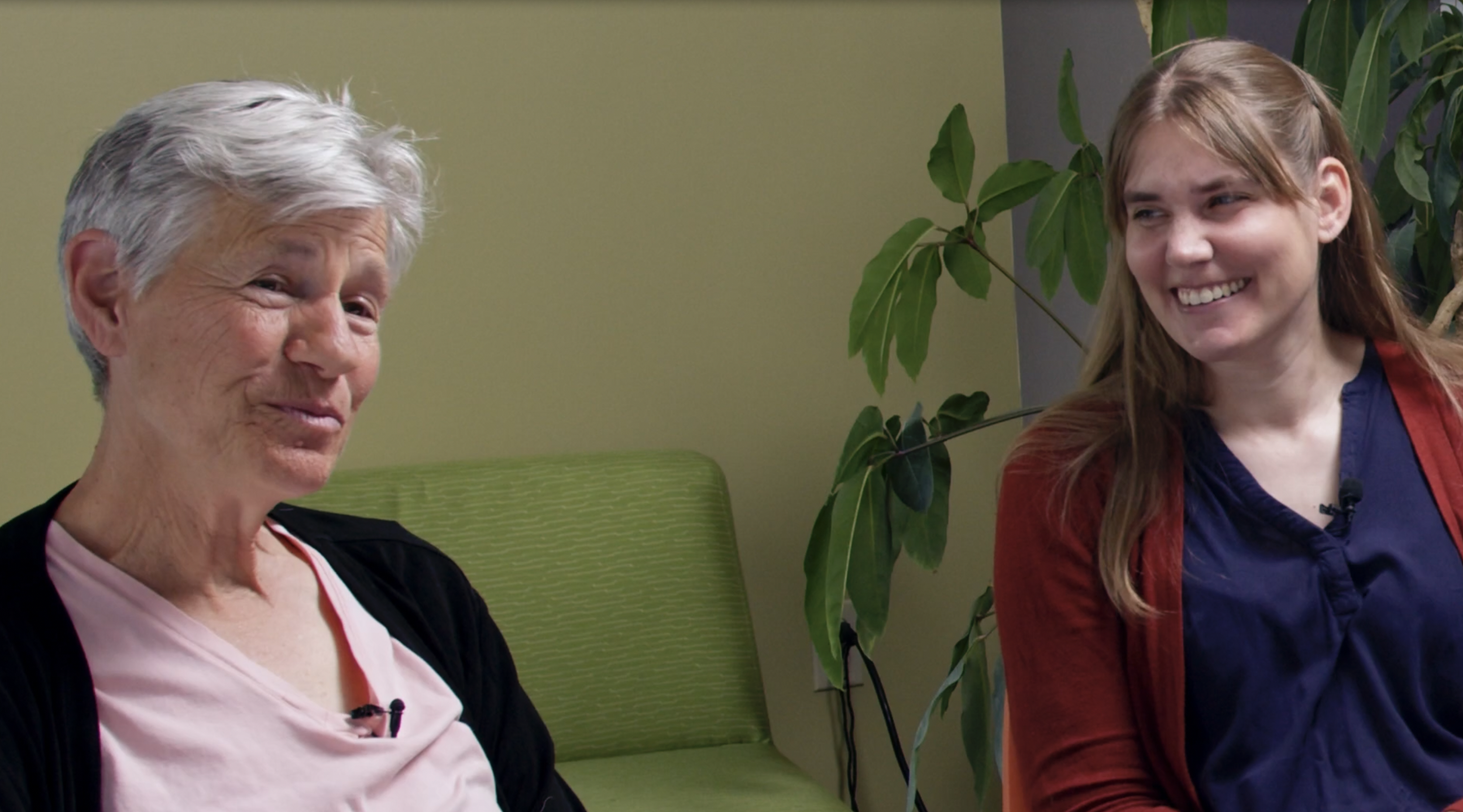
reDirect’s Grant Programs: Learning With Our Partners
Check out this video to learn more about reDirect's grant programs. Listen as our partners share their SEE journey, the particular challenges and environments they tackled under the program, and what they found to be most impactful about the framework.
October 4, 2022.

What’s an Environment, Anyway?
Have you ever wondered what actually makes up an 'environment' and why our environments play such an important role in shaping our day-to-day experiences? Check out this video to learn more.
December 10, 2021.

Building Supportive Online Environments
In an increasingly digital world, more and more people are working, learning, or teaching online. Here are three steps you could take to create more supportive online environments, based on the Supportive Environments for Effectiveness (SEE) framework.
December 10, 2021.

Addressing Mental Fatigue
A brief presentation on Attention Restoration Theory by William Sullivan and Rachel Kaplan.
June 24, 2021.

Finding Focus: Tips for Combatting Fatigue, Distractions, and Burnout
Conventional wisdom tells us that we need to work for as long and as hard as possible to do a good job, but research on attention demonstrates that we are actually far less effective when we try to work in long stretches or do too many things at once. This video features changes that you can make to your environment to help reduce fatigue and burnout.
June 10, 2021.